 Introductory biology can be overwhelming; what we consider to be ‘essential foundation’ could take up an entire undergraduate education. This issue is compounded when we treat the body of knowledge as a collection of names and facts (or when students achieve this view despite our efforts). By viewing the cell as a functioning machine, divided into compartments filled tasks performed by mindless but efficient mechanisms, a course can focus on understanding. A natural framework for student study and learning arises: the mechanics of the cell
Author: Bruce
-
A mechanistic view of the cell: the glory of because
-
Proteins and their functions: execution, modification
Why combine protein function and modification? There’s a reason so many study sites have flashcard features, and it’s not just because they’re easy to program. I think textbooks and lecture can create the impression that introductory biology is nothing but a steady stream of equally-weighted, isolated terms and ‘things’. By finding and teaching relationships, we not only make big concepts easier to see and grasp, we increase the likelihood that they’ll stick and that students will feel a growing sense of power in their grasp of course material. This post will cover a unit that I think ties together a concrete example of enzyme function (ATPase), environmental effects and mechanism of pH (which is further explored in another thematic collection here), and protein control via phosphorylation (which, intriguingly, is achieved through a mechanism related to… ATPase chemistry!).
-
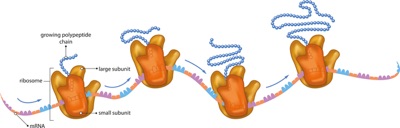
Translation in biology: the Sense of Things
Too often, we seem to act as if first year biology students aren’t ‘smart enough’ to understand things and that it would be ‘easier’ if we just told them the names of things and the order in which they operate. This matches up with no modern model of learning and assumes some magical transformation happens during their sophomore year. Instead, I think we should start them on a diet rich in concepts and unifying themes and ideas. In this first post of what I hope will be a series, I’ll lay out what I think the Big, teachable ideas in the biological process of translation are. -
What’s new: Week of Feb. 16 2015
If you’ve explored the site before, I wanted to provide some updates on things that are newly installed, things that work better, and the Big Thing that I hope to drop on Wed. or Thu. of this week
-

Talk different: delivering biology with meaning
 The first year I did classroom teaching, I thought I was ‘The Natural‘–in reading short answers on my most coveted questions, I repeatedly found myself saying “This is perfect. That’s exactly how I would say it!” Then I realized the underlying problem. Their answers were indeed exactly what I would’ve said–because they were exactly what I had said. This is just a piece of a broader problem; when we use words, they’re labels. These labels may pull up ‘folders’ in our minds that are full of rich, wonderful stuff. These same labels may pull up nothing in a student’s mind–so when we look to the labels as our assessment, we’re grading ourselves as triggered by them, not what they actually possess. Or, as the meme put it (I’ve cleaned it up a little):The three things I learned in college:1) I am [expletive]2) Everyone else is [expletive]3) Mitochondria is the powerhouse of the cellOur field, like many others, is littered with this kind of thing: “ATP is the energy currency of the cell.” “DNA is the genetic material” “DNA holds information through the specific pairing of the nitrogenous bases”, “Enzymes work by lowering the activation energy required for a reaction to go forward” How can we make sure we’re talking sense, and equally important, that students are making sense of our talking?
-
Book review: Sean Carroll’s ‘the Making of the Fittest’
Sean Carroll’s ‘The Making of the Fittest‘ shows up in a number of reference lists for thinkBio; the reason is that he’s put together a wonderful compendium of topics that can make for a compelling Introductory Biology experience. They’re basically molecules whose evolutionary history and roles are interesting and well-understood. The book packages them into interesting units, and also provides a wealth of resources for an instructor wishing to make sure he/she has a sound background in the material being taught.