Author: Bruce

  • Biological timers GTPases in translation, microtubules, signals

    Biological timers GTPases in translation, microtubules, signals

    Hourglass

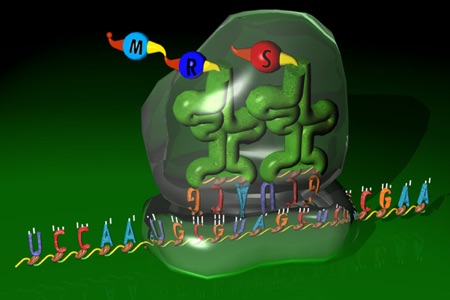
    The main point in teaching with themes is to give students a meaningful sense of familiarity so that their travels from topic to topic are visits with friends and known quantities rather than onslaughts of fresh vocabulary and new un-anchored idea-pieces. One triplet that I have enjoyed using in introductory biology is the set combining 1) EF-Tu and its role in promoting accuracy in translation, 2) the GTPase timer in tubular that gives rise to the grow-catastrophe-disassemble cycle in microtubules, and 3) the ‘self shut-off’ timer features of many G-protein coupled receptors. These are evolutionarily related machines and each applies the concept of ‘timing’ to a different biological circumstance. Thus, besides providing three examples of how biological machines solve problems, this theme ties in to previous ones on ATPase (GTPase mechanism is identical; the attached base has nothing to do with catalysis) and evolution through duplication and modification.
    (more…)

  • What’s important about… Concepts in Translation

    What’s important about… Concepts in Translation

    Teaching biology at the cell/molecular level is challenging; as the Bob Seger song puts it ‘Deadlines and commitments/what to leave in… what to leave out.” How to decide? The glib answer is “identify the key concepts.” A definition of these might be “what are the aspects and ideas without which the process would not make sense, and which, if changed, would rock the cell’s world.” So… what are the Big Concepts of translation? Starting with negation, these cannot be the names or even the structures of the twenty amino acids  (believed to be a combination of what was on hand in abundance ‘in the beginning’ and ‘discoveries’  that were biochemically accessible) nor their codon assignments, which, may reflect some physical correspondences, but seem to largely be a ‘frozen accident’ that we should not expect to find elsewhere. Rant: it cannot be the ability to ‘translate’ a message in a codons-to-amino-acids look-up table, as this has nothing whatever to do with the biological process! And the core cannot be a laundry list of actors and factors.

    The big concepts in translation…

    (more…)

  • Tatham Puzzle Collection: problem solving strategies

    Tatham Puzzle Collection: problem solving strategies

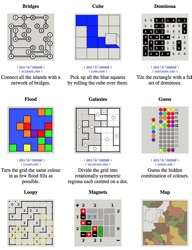
    Tatham puzzle collection imageTo my mind, there are two phases to a lot of classical ‘logic puzzles’. Take Sudoku (spoiler alert! Problem solving strategies already developed & revealed 🙁 ), for example. There is an initial phase where you figure out how to win; then you can play an infinite number of ‘success oriented’ games where you implement  the strategies you developed initially, but rarely or never develop more. I think the initial phase holds the rich opportunities for giving folks an opportunity to develop their problem-solving skills in a meta-cognitive way. So, alongside Petals around the Rose, Bongard Problems, and PatternMaster, I’m linking to Simon Tatham’s Puzzle Collection because it hosts a variety of different problems. Not with the goal of allowing everyone an opportunity to play the one they like, but to explore and learn the ‘tricks’ of  some that are unfamiliar.

    (more…)

  • Bongard Problems: Quickie Scientific Method

    Bongard Problems: Quickie Scientific Method

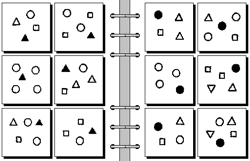
    An example Bongard problemBongard problems are an interesting way to challenge students to make discoveries using problem solving methods. An example (from the site linked at the beginning of this post) is shown below (hit ‘More’). All the Bongard problems have the same underlying premise: the group of six image/object collections on the left are united by some principle that is present in none of the six collections on the right. While it’s easy and fun to simply play this as a game, it’s another example of ‘discovery science’ based puzzle activities a la Petals Around the Rose or PatternMaster.

    (more…)

  • Book review: Guns, Germs & Steel

    Jared Diamond’s book is a wonderful read because it demonstrates the utility of integrating ideas and information from a huge number of fields in order to try to get a handle on questions such as “why did domestication of plants and animals occur where it did, when it did?” and the symmetric “why did such events not take place earlier or later or elsewhere?”. The text showcases an active curiosity as well as the value of gathering information–and determining what information can illuminate a question. All the pieces are assembled to argue that the titular elements arose as consequences of… lots of food.

    (more…)

  • Book review: the Eighth Day of Creation

    Horace Judson’s “The Eighth Day of Creation” (only available used, to my knowledge, but worth every penny and who cares if your copy is a little tattered) was a foundational book for me in the path that lead to my career. It makes fascinating reading for anyone interested in how science actually takes place–conversations, inspirations, blind alleys, discovery. A brief book review follows.

    (more…)