While primarily claimed by chemistry (and rightly so, I grudgingly admit), the periodic table is a delightfully clear example of DISCOVERY science and of fundamental importance to an understanding of Biology. I’m creating a distinction here between what I might call ‘fill in the gaps’ science or ‘next steps at the endpoints’ science because I think students are exposed almost exclusively to the latter two. In this usage, discovery science would be discerning a new law or pattern in nature, establishing an ordering principle, or revealing something transcendent. Many of these situations arise because of recognition of ordering patterns; the periodic table is perhaps one of the most clear and readily understood.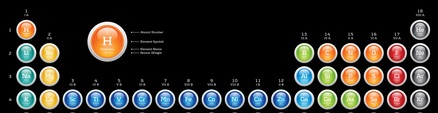
Author: Bruce
-
Patterns in scientific discovery: the Periodic Table
-
Death by 1000 cuts: Vocabulary in Introductory Biology
I have read that the average number of new words of vocabulary in introductory biology textbooks exceeds that found in… a foreign language learning text. This can’t be well-considered; new words are the primary purpose of a foreign language course; they are a barrier to understanding in a Biology course
Some thoughts on how vocabulary in introductory biology is a horrific educational crime, and concrete proposals about what can be done, as well as available tools, follow
-
What’s important about… Key Concepts in Biology
Before we design courses, textbooks, assessments, labs, we need to determine what is important to teach
 in Introductory Biology. I think we’ve failed to do that, or at the very least confused concepts with content. Part of the problem is historical–textbooks are a product of inertia, each new one modeled on the ones that came before rather than initiated de novo to reflect principles in biology or pedagogy. Secondarily, I think a lot of effort in revamping biology curricula is being driven by older efforts in Chemistry and Physics, where a lot of the critical material is more operational and less conceptual. I’m writing this post to lay out one possible schema.
-
PatternMaster: Real Scientific Method
Sitting in a classroom, a beginning biology student can easily come away with the impression that the Joy of Science lies in memorizing what is already known… and that historical problem solving and experimentation was about confirming what was obvious or inevitable. This describes no one I have ever worked with, and no lab I’ve ever worked in. The challenge is in delivering the excitement of figuring things out; too many labs are about taking (often stale) data.
PatternMaster (now playable via web/tablet!) lets students make discoveries about how things work using the Scientific Method. To quote the NGSS ‘Crosscutting concepts’:
1. Patterns. Observed patterns of forms and events guide organization and classification, and they prompt questions about relationships and the factors that influence them.
-

Problem solving: Petals around the rose
From time to time, I’m going to add websites or problems that I think challenge visitors in rich ways. One of my very favorites is a little wonder called “Petals around the rose”. There is a nice implementation by Lloyd Barrett on his website. Prepare to spend some time on this, and don’t bother going if you’d ever contemplate doing a web search for solutions. If it takes you a week to solve, it’s a well-spent week. It took me several days (so no, I don’t want to hear about it if you solve it simply after visual inspections 🙂 ). There are several problem solving aspects that I think make this a rich experience… [No spoilers below] -

What’s important about… ATP?
Every Intro Bio student can cite ATP as ‘the energy currency of the cell’… but what do we mean by that? And why does it play that role? These are important questions, and they deserve answers. And real ones, not invocation of the mystical ‘high energy bonds’.
Perusing Wiki for an image to link for ATP, I’m surprised to find how many directly imply that the ‘value’ is in the bond between two phosphates. I think suggesting that this is the case does a disservice to students’ ability to analyze and understand. We’ve taught them by now that bonds are simply shared pairs of electrons. Blaming the bond for the potential energy inevitably raises the question “Is it the electrons that are special? If not, what is it about the bond?”. No and nothing.